
Introduction
Hidden among the towering cliffs of central Mali lies one of Africa’s most fascinating tribes the Dogon people. Famous for their intricate cosmology, unique cliffside architecture, masked dances, and secretive spiritual traditions, the Dogon have intrigued anthropologists, historians, and even NASA scientists for decades. From their breathtaking homes carved into rock faces to their detailed knowledge of celestial bodies, the Dogon are a culture where earth and sky meet in mystery.
Location
The Dogon people live primarily in the Bandiagara Escarpment, a dramatic sandstone cliff that stretches over 150 kilometers in Mali. Their settlements are nestled along the cliffs and plateau regions, with some villages built directly into the rock face a feat of ancient engineering and defense. The area has been recognized as a UNESCO World Heritage Site due to its cultural and historical significance.
Demography
The Dogon number between 600,000 and 800,000 people. Though primarily located in Mali, small Dogon communities can also be found in Burkina Faso and Niger. The population is spread across over 700 villages, each with its own variations of customs, though all rooted in shared Dogon identity and spirituality.
Linguistic Affiliation
The Dogon speak several dialects within the Dogon language family, which is considered part of the Niger-Congo linguistic group. Each village may have a slightly different dialect, yet they maintain mutual intelligibility. Many Dogon people also speak Bambara (a widely spoken language in Mali) for broader communication and trade.
History and Cultural Relations
According to oral tradition, the Dogon migrated to their current region between the 10th and 13th centuries, fleeing religious persecution possibly from Islamic invasions and settled in the cliffs for protection. Their unique culture has since evolved in isolation, preserving pre-Islamic African traditions.
The Dogon are known for their rich mythology, particularly their early understanding of astronomy. Centuries before modern science, they described Sirius B, a star invisible to the naked eye but later confirmed by telescopes in the 20th century leading to global fascination and debate about how they acquired such knowledge.
Settlements
Dogon villages are marvels of adaptation and symbolism. Built into the steep cliffs of the escarpment, their mud and stone homes rise like sculptures against the sky. Granaries, shrines, and sacred altars are precisely positioned to align with spiritual beliefs.
Their settlements are organized hierarchically with toguna (men’s meeting huts), women’s houses, and ancestor sanctuaries. Narrow pathways connect homes, and every architectural detail from door carvings to rooftop shapes holds spiritual meaning.
Trade
The Dogon have long engaged in local and regional trade, exchanging millet, onions, tobacco, and pottery for salt, fabrics, and livestock. In recent decades, tourism has become a significant economic activity, with visitors drawn to their cliff dwellings, vibrant festivals, and striking wooden masks.
They are also known for their craftsmanship, especially in weaving, iron-smithing, and wood carving creating goods for both functional and ceremonial use.
Marriage
Dogon marriages are complex and often arranged by families. The society is patrilineal, and girls usually marry young, often moving into their husband’s family compound. A notable custom is the sigi ceremony, held once every 60 years, which represents the renewal of life and unity across all Dogon generations.
Polygamy is practiced, but each wife has her own space and role. Fertility is highly valued, and childbearing is a central aspect of a woman’s social status.
Religion
The Dogon maintain a rich cosmology and spiritual belief system, centered around a supreme god Amma, ancestral spirits, and the Nommo twin spiritual beings sent by Amma to create order in the universe.
Their religion is expressed through ceremonial dances, mask rituals, and secret initiations.
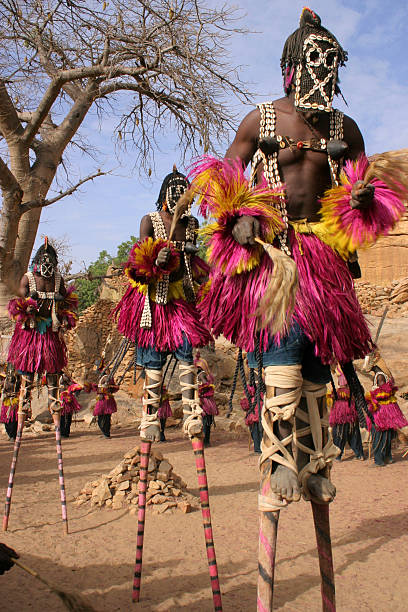
One of the most iconic aspects of Dogon spirituality is their masked dance festivals, where elaborately carved masks represent different spirits, animals, and cosmic forces. These events are not just performances but deeply sacred acts of communication with the divine and the ancestors.
Uniqueness
What truly sets the Dogon apart is their astronomical knowledge and spiritual architecture. Long before the telescope, they described Sirius B, a companion star to Sirius, with remarkable accuracy. They understood its orbital path and density, which has led some to speculate about ancient contact with outside civilizations though others attribute this knowledge to symbolic interpretation passed through generations.
Their mask-making tradition is another cultural treasure, with over 80 distinct mask types, each linked to a myth or spiritual principle. These masks are not just artistic they are seen as living spirits and used in rituals that mark death, harvest, initiation, and cosmic alignment.
The Dogon people have also preserved a calendar system based on the cycles of Venus and Sirius, complex initiation rituals, and a philosophy that blends nature, the stars, and the soul into a single, unified worldview.
Conclusion
The Dogon Tribe is a living library of African wisdom carved in stone, painted in dust, and whispered through centuries of ritual. They are not just survivors of history but guardians of cosmic stories and earth-bound spirituality.
As modernity stretches across Mali and beyond, the Dogon stand firm on their cliffs, watching the stars, listening to the wind, and keeping sacred what the world often forgets the deep, ancient dance between humanity and the universe.

Leave a Reply