
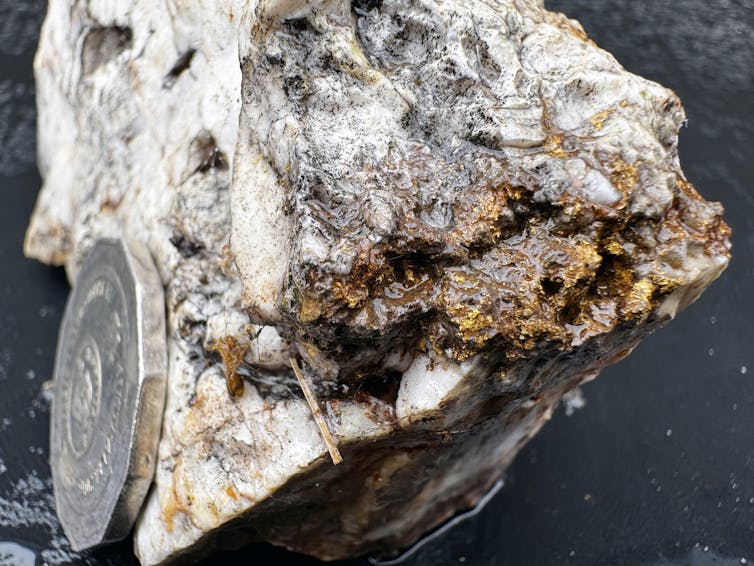
The Sahel region of Africa, particularly in countries like Mali, Burkina Faso, and Niger, has recently seen military regimes urging Western mining firms to ensure a fairer distribution of revenue from the area’s rich mining sector. At the center of these tensions is one of the world’s most sought-after resources: gold.
A Historical Gold Hub

West Africa has been synonymous with gold mining for centuries. Its reputation as the “Land of Gold” dates back to the ancient Ghana Empire, which thrived on abundant gold reserves and dynamic trade networks. Even today, West Africa remains a global leader in gold production, contributing about 10.8% of the world’s total gold output as of 2024.
Most of West Africa’s gold reserves are concentrated within the West African Craton, an ancient geological formation that spans several countries, including Mali, Ghana, Burkina Faso, Côte d’Ivoire, Guinea, Senegal, and Mauritania. This craton, one of the world’s oldest continental crusts, has remained largely unchanged for billions of years, making it a hotspot for gold prospecting.
The craton’s gold deposits formed during the Eburnean Orogeny—a major tectonic event that occurred between 2.2 and 2.08 billion years ago. The volcanic and tectonic processes of this era created the Rhyacian Birimian granitoid-greenstone belts, which host most of the region’s gold reserves. Ghana and Mali lead the region in terms of gold endowment, accounting for over 57% of West Africa’s total gold production and resources.

– Ghana: Known to house 1,000 metric tonnes of gold, Ghana produces 90 metric tonnes annually, representing 7% of global production.
– Mali: With an estimated 800 metric tonnes of gold deposits, Mali produced 67.7 tonnes in 2023.
For comparison, the world’s largest gold producers, China and Australia, mined 370 and 310 metric tonnes of gold in 2023, respectively.
Modern Tools for Gold Exploration
Gold prospecting has evolved significantly from traditional panning and shallow pit digging. Today’s tools and techniques include:
1. Geophysical Surveys and Data Analytics
Geochemical exploration, advanced geophysical surveys, and chemical extraction methods like cyanide leaching have revolutionized gold mining. By combining remote sensing data with machine learning, geologists can create more accurate maps and reduce exploration risks.
2. Artificial Intelligence
Deep learning techniques analyze geological datasets to identify features and predict areas with a high potential for gold mineralization. These methods have proven effective in discovering new deposits.
3. Stable Isotope Analysis
Stable isotopes, such as carbon, hydrogen, and oxygen, provide another innovative method. Gold-bearing fluids leave unique isotopic signatures in rocks during their interactions. Identifying these signatures serves as a proxy for locating gold deposits, offering an efficient and cost-effective alternative to traditional geochemical approaches.
Conclusion
West Africa’s wealth in gold is rooted in its ancient geology and historical significance as a mining hub. Modern exploration tools, combined with advances in data analytics and stable isotope research, continue to unlock new potential for mining in the region. As governments and companies negotiate fairer revenue distribution, West Africa’s position as a global gold powerhouse remains undisputed.
Leave a Reply