
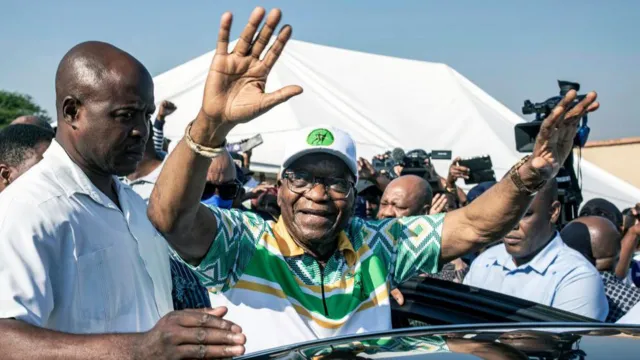
Former South African President Jacob Zuma has once again proven his resilience in the political arena. Despite facing numerous corruption allegations, a rape trial, and imprisonment for contempt of court, the 82-year-old leader has made a remarkable comeback. His newly formed party, uMkhonto weSizwe (MK), gained 15% of the vote in the recent election, dealing a significant blow to the African National Congress (ANC), the party he once led.

Zuma’s influence in his home province of KwaZulu-Natal is evident, with his smiling face adorning election posters throughout the city of Durban. His supporters revere him for his cultural and traditional Zulu beliefs, his role as a peace broker during political violence in the early 1990s, and his ability to bring voters from the Zulu nationalist Inkatha Freedom Party to the ANC over 20 years ago.
Despite being forced out of the presidency in 2018 and serving time in prison, Zuma’s loyal supporters have remained steadfast. His ability to connect with the poor and marginalized has endured, and his party’s manifesto launch at a packed 40,000-seater stadium in Soweto was a clear signal of his return to politics.
Zuma’s political career has been marked by numerous scandals and allegations, including corruption charges related to a 1999 arms deal and a rape trial in 2005, of which he was acquitted.
However, his supporters remain loyal, and his party’s performance in the recent election has humbled the ANC, which has lost its outright parliamentary majority for the first time in 30 years.

With coalition talks underway, Zuma’s MK party has made it clear that it will only form a partnership with the ANC if President Cyril Ramaphosa resigns. Zuma has alleged irregularities in the election results, and police are on alert for potential unrest. Despite this, the ANC has not ruled out a coalition with the MK party, acknowledging Zuma’s enduring influence in South African politics.
Leave a Reply