
Introduction
The Amazighs, also widely known as Berbers (a term now considered less preferred), are the indigenous people of North Africa. Their history spans thousands of years, long before Arab conquest, and their presence extends from Morocco to Libya and deep into the Sahel. Despite periods of marginalization, the Amazigh identity remains vibrant and deeply rooted in oral tradition, resistance, and a strong connection to land and language.
Origins & History
The Amazighs trace their ancestry back to prehistoric times, with archaeological evidence pointing to settlements dating as far back as 10,000 BCE. They were key players in ancient trade routes and interacted with Phoenicians, Romans, Byzantines, and later the Arab caliphates. Their kingdoms—such as Numidia and Mauretania—were once powerful and semi-independent. The Arab conquest in the 7th century CE led to a gradual Islamization, but many Amazigh groups retained distinct cultural practices and resisted full Arab assimilation.
Geography & Environment
The Amazighs inhabit a wide geographic area that includes the Atlas Mountains, the Rif, the Sahara, and the Kabyle region. These diverse environments have shaped their lifestyle—from highland farming and shepherding to desert trade. Today, Amazigh communities can be found in Morocco, Algeria, Tunisia, Libya, Mali, and Niger.
Language & Identity
The Amazigh people speak Tamazight, a family of Afroasiatic languages with several regional dialects like Tarifit, Tachelhit, and Kabyle. Their language, written in the ancient Tifinagh script, has seen a cultural revival in recent decades. In both Algeria and Morocco, Amazigh has been recognized as an official language, reinforcing their fight for visibility and identity.
Social & Political Organisation
Traditionally, Amazigh communities were organized in tribes or clans with councils of elders making decisions. Many were known for their democratic village governance and resistance to external rule, including Arab and French colonization. In modern politics, Amazigh activism continues to push for cultural and linguistic rights, land ownership, and representation.
Cultural Practices & Traditions
Hospitality, storytelling, music, and oral poetry are core to Amazigh culture. Ceremonies like weddings are rich with symbolism, henna rituals, and traditional songs. Women often play a central role in preserving traditions, passing down stories, and crafting symbolic tattoos that serve as cultural markers.
Material Culture
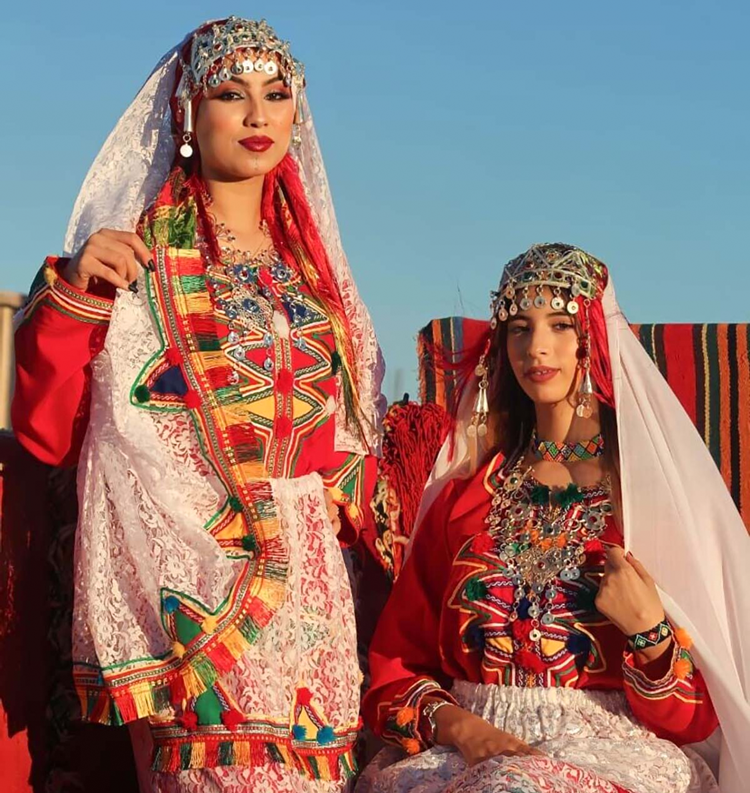
The Amazigh are renowned for their colorful textiles, silver jewelry, and pottery. Their clothing such as the djellaba or haik—features symbolic embroidery, while jewelry often carries protective meanings. Tents in desert areas and stone houses in the mountains reflect their adaptability to the environment.
Beliefs & Worldview
While most Amazighs are Muslim, many retain pre-Islamic customs and spiritual beliefs. These include nature worship, veneration of saints (marabouts), and the belief in baraka (spiritual blessing). Traditional medicine, often guided by women or elders, is still practiced in remote areas.
Economy & Livelihood
Historically, Amazighs were traders, farmers, and herders. Many groups facilitated trans-Saharan trade, especially in salt, gold, and slaves. Today, subsistence farming, carpet weaving, and artisan goods remain vital. Migration—both internal and international is common, with remittances supporting local economies.
Festivals & Celebrations
The Amazigh New Year (Yennayer), celebrated in January, is a major cultural event. It features communal meals, dances, and traditional clothing. Other festivities revolve around harvests, Islamic holidays, and seasonal transitions, often blending religious and ancestral rites.
Art, Music & Performance
Music is an essential cultural expression, with instruments like the bendir (frame drum), ghaita (oboe), and imzad (bowed lute). Amazigh music often features call-and-response vocals and poetic lyrics. Dances such as the Ahwach and Ahellil are performed at communal gatherings and festivals.
Contemporary Life & Challenges
Despite official recognition in some countries, Amazigh communities still face challenges: limited access to education in their language, land disputes, underrepresentation, and erosion of traditions due to globalization. However, a strong cultural revival movement especially among youth is gaining momentum through literature, media, and activism.
Notable Figures & Stories
Kahina: A legendary 7th-century Amazigh queen who resisted Arab invasions.
Ibn Battuta: Though more commonly identified as Arab, the famed traveler had Amazigh roots.
Taos Amrouche: An Algerian Amazigh writer and singer known for preserving Kabyle oral poetry.
Visiting & Ethical Engagement
Respect local customs, particularly regarding dress and photography.
Learn a few Tamazight phrases to show respect.
Support local artisans and cooperatives.
Understand the historical context of marginalization and be mindful in interactions.


Leave a Reply