
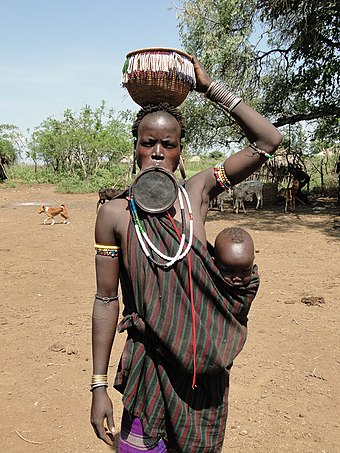
The lip plate, also known as a lip plug, lip disc, or mouth plate, is a distinctive form of body modification. It involves inserting progressively larger discs, typically made of clay or wood, into a pierced hole in the upper or lower lip—sometimes both—gradually stretching the lip. The term labret refers to various types of pierced-lip ornaments, including plates and plugs.
Historical Origins
Archaeological evidence indicates that disk and plate labrets have been independently developed multiple times throughout human history. These include findings from:
– Africa (Sudan and Ethiopia, 5500–6000 BCE)
– Mesoamerica
-Coastal Ecuador
Regional Practices
In some African cultures, lower lip plates are often combined with the removal of the lower front teeth, sometimes involving all four. Among the Sara and Lobi people of Chad, plates may be inserted into the upper lip as well. Conversely, the Makonde people of Tanzania and Mozambique traditionally used upper lip plates exclusively.
The size of the lip plate is often interpreted as an indicator of social or economic status in certain communities. However, the final size is largely determined by the skin’s natural elasticity and the wearer’s preferences.
The Surma and Mursi of Ethopia
Among the Surma and Mursi people in the Omo River Valley, the tradition typically begins 6 to 12 months before marriage, usually when a young woman is between 15 and 18 years old. The process involves the following steps:
1.Piercing:A 1-2 cm incision is made in the lower lip, usually by the mother or a close female relative. A wooden peg is then inserted.

2.Stretching: After a healing period of 2-3 weeks, larger pegs are progressively used until the lip is stretched to accommodate a clay plate.
3. Crafting the Plate: Women design and create their plates, often adding decorative details. The final diameters can range from 8 cm to over 20 cm.
Some sources, such as Beckwith and Carter (1990), suggested that the size of the lip plate indicated the number of cattle paid as a bride price. However, anthropologist David Turton, who studied the Mursi for three decades, disputes this claim. Amanda LaTosky, another anthropologist, argues that lip plates are a source of pride, symbolizing female strength and self-esteem.

Contemporary Perspectives
In modern times, girls aged 13 to 18 generally decide whether or not to adopt this tradition. Nonetheless, the practice has turned Mursi and Surma women into tourist attractions, raising discussions about cultural preservation and exploitation.
Record Breaking Lip Plate

The largest recorded lip plate, belonging to Ataye Eligidagne from Ethiopia, measured 59.5 cm (23.4 in) in circumference and 19.5 cm (7.6 in) in diameter, as documented in 2014.
The practice of using a lip plate is complex and carries deep symbolism. It represents both cultural identity and individual choice in the communities where it is still practiced.
Leave a Reply