
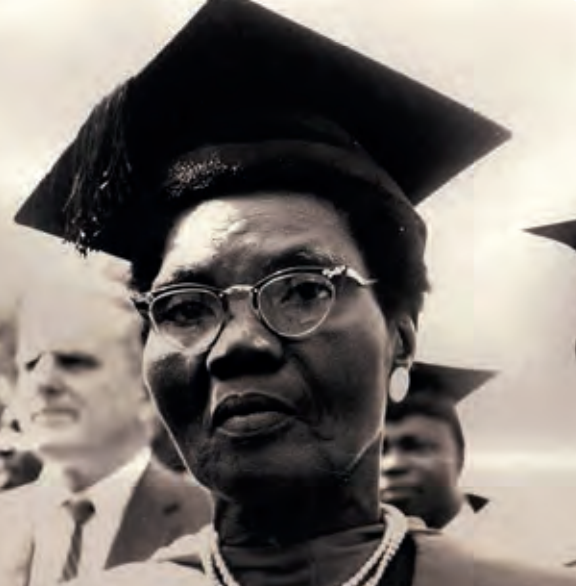
Funmilayo Ransome-Kuti, an educator, political campaigner, and women’s rights activist, was born Frances Abigail Olufunmilayo Olufela Folorunso Thomas on October 25, 1900, in Abeokuta, Nigeria. Her parents, Chief Daniel Olumeyuwa Thomas, a prominent farmer, and Lucretia Phyllis Omoyeni Adeosolu, a dressmaker, were influential figures in their community.
In 1914, Ransome-Kuti was one of the few girls admitted to Abeokuta Grammar School, an achievement that paved the way for her to attend an all-girls finishing school in England. It was during her time in England in the 1920s that she embraced socialism and anti-colonialism, deepening her commitment to her Nigerian heritage. Upon completing her education, she returned to Abeokuta, where she took up a career in teaching.
At the age of 25, she married Reverend Israel Oludotun Ransome-Kuti, a school principal and community leader. They shared 30 years of marriage and had four children, one of whom was the internationally renowned musician Fela Kuti. Despite having to leave teaching after her marriage, Ransome-Kuti became even more involved in political activism. In 1928, she founded a self-improvement group for young women, and by 1936, she became the first woman in Abeokuta to drive a car after she and her husband purchased one.
Ransome-Kuti’s political journey took a significant turn in 1944 when she founded the Abeokuta Ladies’ Club, which later became the Abeokuta Women’s Union (AWU). This organization was instrumental in her fight for women’s political, social, and economic rights. In 1949, she earned the title “The Lioness of Lisabi” for leading a revolt of Egba women against both British colonial authorities and the local monarch, Oba Ademola II. The women protested oppressive taxation and gender-based discrimination, especially the practice of taxing girls as young as 15, while men were taxed only after age 18. The revolt ultimately led to the abdication of Oba Ademola II.
Following this success, Ransome-Kuti was elected the first president of the AWU, which united elite, educated women with market women. She expanded the organization into the Nigerian Women’s Union (NWU) in 1949, and later, in 1953, formed the Federation of Nigerian Women’s Societies (FNWS), a national platform advocating for women’s rights.
In 1959, Ransome-Kuti founded the Commoner’s People’s Party to oppose the colonial government, after being expelled from the National Council of Nigeria and the Cameroons (NCNC). She campaigned vigorously for women’s suffrage and Nigerian independence, which was achieved in 1960. Despite facing accusations of communism and surveillance by both Nigerian and foreign governments, Ransome-Kuti continued her advocacy. Her passport renewal was denied, preventing her from traveling to the U.S., yet she remained undeterred, fighting for women’s rights both at home and abroad.
Tragically, in 1977, her son Fela’s Lagos compound was raided by Nigerian soldiers. During the raid, the 76-year-old Ransome-Kuti was thrown from a second-story window, sustaining injuries that she never recovered from. She died on April 13, 1978, at the age of 77.
Funmilayo Ransome-Kuti remains a towering figure in Nigeria’s history, remembered as a fearless champion for women’s rights and one of the most influential leaders of the 20th century.
OUR HEROES PAST: OLUWAFUMILAYO RANSOME KUTI
By
Read Next:
Hey!
Hey, dear visitor! Whether you’re here to know about African history, culture and news, or just stay in the loop with the latest events in Africa, you’re in the right place. This blog is all about sharing the coolest things in Africa. Hit that follow button, and let’s explore Africa together! 🚀
Join the Club
Stay updated with our latest tips and other news by joining our newsletter.
Tags
#Adulthood #Adulthood #PCOS Awareness #young girl child# health care #Africa #Africa Hairstyles #African History #Africa #Africa history #Africa root #Africa Countries #Africa #Africa history #Africa root #The Bambuti tribe #Africa #African Country #infrastructure #economic growth #Africa #beautyinafrica @wildlifebeauties #kenya #tanzania #Africa #Breaking # News #Africa #Breaking # News #Nigeria #cybersecurity #levy #economy #Africa #Breaking # News #southafrica #Apartheid #Economic instability #Africa #Breaking # News #southafrica #Apartheid #Election #Zuma #Africa #Breaking # News #SouthAfrica #Election #ContentCreators #SocialMedia #Africa #Breaking #Nigeria #insecurity #death #economy #fire #Africa #Country Names #Africa identity #Africanculture #Africanspirituality #childrensafety #Greatness #LGBTQ #news #Africa #Nigeria #trends #entertainment #Music #Non-digitalskills #personalgrowth #Productivity #slave trade #UgandanAthleteAttackedInKenya #PetrolAttackOnFemaleRunner #ViolenceAgainstFemaleAthletes #RebeccaCheptegeiFightForLife #KenyaCrimeAgainstWomen #AthleteSurvivesPetrolAttack #GenderBasedViolenceInKenya #UN AFCON africa African youth Africa to the world food football Ghana health Ivory Coast mental-health News Nigeria power woman self-esteem social media sports technology youth youth advocacy
Leave a Reply